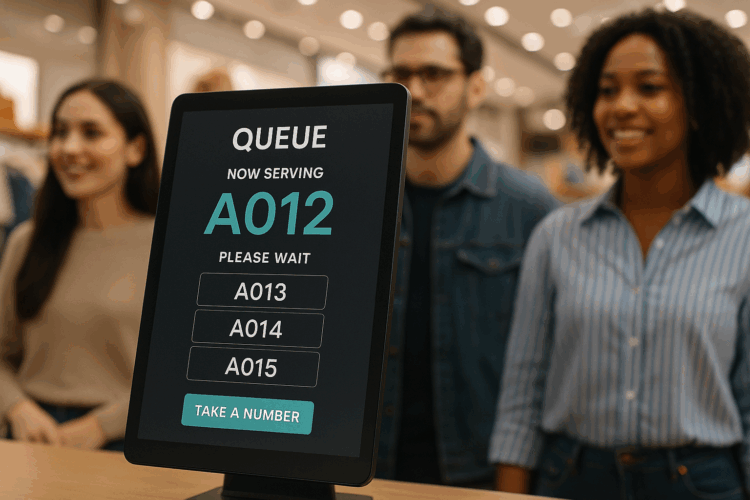

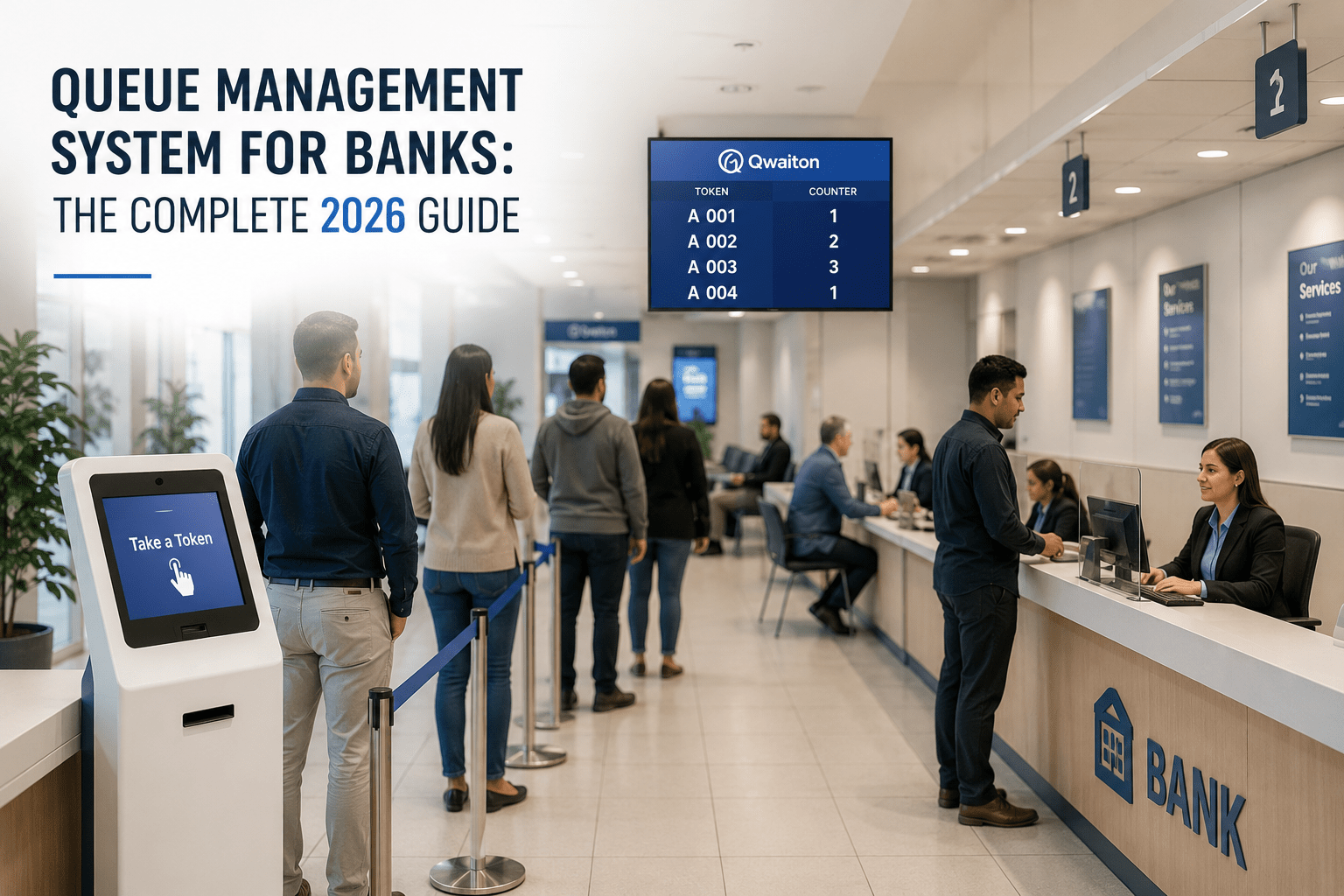
Walk into almost any bank branch today and you will notice something has changed. The long frustrated lines of a decade ago are disappearing. They are being replaced by digital ticketing screens, SMS alerts and customers who simply check their phone to see how long they will wait. That shift did not happen by accident. It happened because banks started investing in queue management systems.
If you are researching how queue management works for banks, or you are a bank manager trying to fix long wait times and staff overload, this guide breaks it all down in plain language. No jargon. Just what you need to know in 2026.
What Is a Queue Management System for Banks?
A queue management system (QMS) is software that organizes how customers are served at a branch. Instead of customers physically standing in line, they take a digital ticket from a kiosk, a mobile app or a QR code scan. The system then tells them where to go, when and to which counter.
Behind the scenes the system tracks everything. It records how many customers are waiting, how long each transaction takes, which staff member is free and which service is in demand at any given moment. This includes loan inquiries, account opening and cash deposits.
In short, it replaces guesswork with data. In 2026, with customer patience shorter than ever and digital expectations higher than ever, that data is what keeps a branch running smoothly.
Why Banks Still Need Queue Management in a Digital First World
A common question bank managers ask is this. If everyone is banking on their phone why do we still need a queue system for the branch?
The honest answer is that branches have not disappeared. They have changed purpose. Customers now visit branches mainly for things that cannot be done online. This includes opening new accounts, resolving disputes, applying for loans, notarizing documents and getting financial advice. These are higher value and higher emotion interactions. That means the experience matters more not less.
Here are a few reasons queue management remains essential for banks in 2026.
- Customer expectations have shifted. People are used to real time tracking from food delivery and ride hailing apps. They expect the same transparency at the bank.
- Branch footfall is more appointment like. Fewer but more complex visits mean each customer interaction needs to be handled efficiently and fairly.
- Regulatory and compliance pressure is rising. Banks need to document service times and prove fair non discriminatory service. Manual queues simply cannot track this.
- Staffing costs are increasing. Banks need accurate data to know when to schedule more tellers and when they can run leaner.
Key Features Every Bank Should Look For
Not all queue management systems are built the same. If you are evaluating options for a bank branch here are the features that actually move the needle.
1. Multi Channel Ticketing
Customers should be able to join a queue from a kiosk, a QR code or a mobile app, even before arriving at the branch. This is sometimes called virtual queuing and it is quickly becoming the standard expectation rather than a bonus feature.
2. Service Based Routing
Not every customer needs the same counter. A good system separates queues by service type such as cash transactions, loan desks and customer service. It then routes people automatically so a five minute withdrawal does not get stuck behind a thirty minute loan consultation.
3. Real Time Wait Time Estimates
Customers want to know one thing. How long until it is my turn? Modern systems calculate this dynamically based on live data rather than a fixed average.
4. Staff and Counter Management Dashboard
Branch managers need visibility into which counters are active, which staff are idle and where bottlenecks are forming. All of this should be visible in real time from a single dashboard.
5. Analytics and Reporting
This is where queue management becomes a business tool and not just a convenience. Reports on peak hours, average service time and customer volume per service type help banks plan staffing, design better branch layouts and meet compliance requirements.
6. Integration with Core Banking Systems
A queue system that connects with your CRM or core banking software can pull up customer history the moment they are called. Staff do not have to start from zero with every interaction.
The Real Benefits Banks Actually Gain
It is easy to list features. But what does this actually mean for a bank’s bottom line and reputation?
Shorter perceived wait times. Even when actual wait time does not change much customers who can see their position in line and get live updates feel like the wait is shorter. They are far less likely to leave frustrated.
Better staff allocation. Managers can see exactly where congestion is happening and shift staff accordingly instead of relying on guesswork or complaints.
Improved customer experience scores. Wait time is consistently one of the top complaints in banking customer satisfaction surveys. Fixing it directly improves customer satisfaction scores and branch reviews.
Data backed decision making. Instead of assuming Mondays are busy banks can confirm it with real numbers. They can then staff and even redesign branches based on actual customer flow patterns.
Reduced no shows and walkouts. When customers know how long they will wait fewer of them abandon the queue altogether. This means fewer missed opportunities for service completion.
How Qwaiton’s Queue Management System Works for Banks
Qwaiton was built with exactly this problem in mind. It helps service based institutions including banks turn chaotic waiting areas into organized data driven operations.
Here is the simple version of how it works.
- Customer joins the queue through a branch kiosk, a QR code scan or the Qwaiton app, and selects the specific service they need.
- The system assigns a ticket and an estimated wait time calculated from real time branch activity rather than static averages.
- Customers get live updates on their phone or through the display screen so they are free to wait comfortably instead of standing in line.
- Staff call customers through a simple dashboard with full context on the service they need.
- Branch managers monitor everything live. This includes queue length, average wait time and staff load, and they can adjust on the spot.
- After the visit data flows into reports that help leadership understand patterns across single or multiple branches.
For banks operating multiple branches this also means head office can compare performance across locations and standardize service quality everywhere, not just at the busiest branch.
Best Practices for Implementing Queue Management in a Bank Branch
If you are planning a rollout a few practical tips can save you a lot of friction.
- Start with one or two pilot branches before a full rollout. This lets you fine tune service categories and staff workflows based on real feedback.
- Train staff on the why and not just the how. Adoption is smoother when staff understand that the system reduces their workload rather than seeing it as extra monitoring.
- Customize service categories to match your actual branch traffic. Generic categories rarely fit a real bank’s mix of transactions.
- Review analytics monthly and not just during a crisis. The biggest value of a QMS often comes from small ongoing adjustments rather than one big fix.
- Combine virtual queuing with in branch options. Not every customer has a smartphone in hand when they walk in so kiosks still matter.
Frequently Asked Questions
Does a queue management system reduce actual wait time or just make it feel shorter?
Both. The data driven staff allocation reduces actual bottlenecks while live updates and transparency reduce the frustration of whatever wait time remains.
Can a queue management system work across multiple bank branches?
Yes. Modern platforms like Qwaiton are built to run centrally and give head office a single view across all branch locations.
Is this only useful for large banks?
No. Smaller banks and microfinance institutions often see the fastest improvements since even one or two well placed staff adjustments can significantly cut wait times in a smaller branch.
How long does implementation usually take?
Most branches can go live within a few weeks especially when starting with a single pilot location before a full rollout.
[INTERNAL LINK: Read our case study on bank branch efficiency]
Final Thoughts
Queue management for banks is not just about making lines shorter. It is about giving branches the data and structure to run like a modern service business. In 2026, with customer patience thinner and digital expectations higher than ever, a smart queue management system is no longer a nice to have. It is becoming a baseline expectation the same way mobile banking apps became one a decade ago.
If your bank is still relying on a numbered ticket printer and a hopeful guess about wait times it is worth seeing what a modern system like Qwaiton can do differently.

Author